

Shortwave radio has long been a playground for hobbyists, conspiracy theorists, and curious listeners. Unlike the clean digital streams of modern media, shortwave is raw, unpredictable, and occasionally deeply unsettling. Among the squeaks, buzzes, and static, there exist signals that have spawned legends, inspired novels, and remain only partially explained. The best part is that anyone with an internet connection can hear them right now for free, using online software-defined radios (SDRs).
What makes shortwave different from other radio?
Most people are familiar with VHF and UHF radio: walkie-talkies, FM broadcasts, police scanners, and the like. These signals travel along the ground or through line-of-sight and are blocked by the curvature of the Earth. Shortwave, officially the high-frequency (HF) band from 3 to 30 MHz, behaves differently. Under the right atmospheric conditions, shortwave signals can bounce off the ionosphere and return to Earth hundreds or even thousands of miles away. This phenomenon, known as skywave propagation, allows a receiver in California to pick up a transmission originating in Europe or Asia.
This unique ability made shortwave the backbone of international broadcasting for much of the 20th century. It also made it indispensable for military, diplomatic, and intelligence communications. Even today, many of the strangest signals on the airwaves are remnants of these Cold War-era systems or current operations that still rely on HF for its resilience and long range.
How to listen without buying a radio
Until recently, tuning into shortwave required a dedicated receiver, a large antenna, and often a license for transmitting. The rise of internet-connected SDRs changed everything. Websites like rx-tx.info aggregate thousands of public SDR receivers around the world. These are categorized by type: KiwiSDR (purple markers) often have pre-tagged interesting frequencies; OpenWebRX (green) use RTL-SDR dongles and offer extensive customization; WebSDR (blue) are high-value scientific or research receivers.
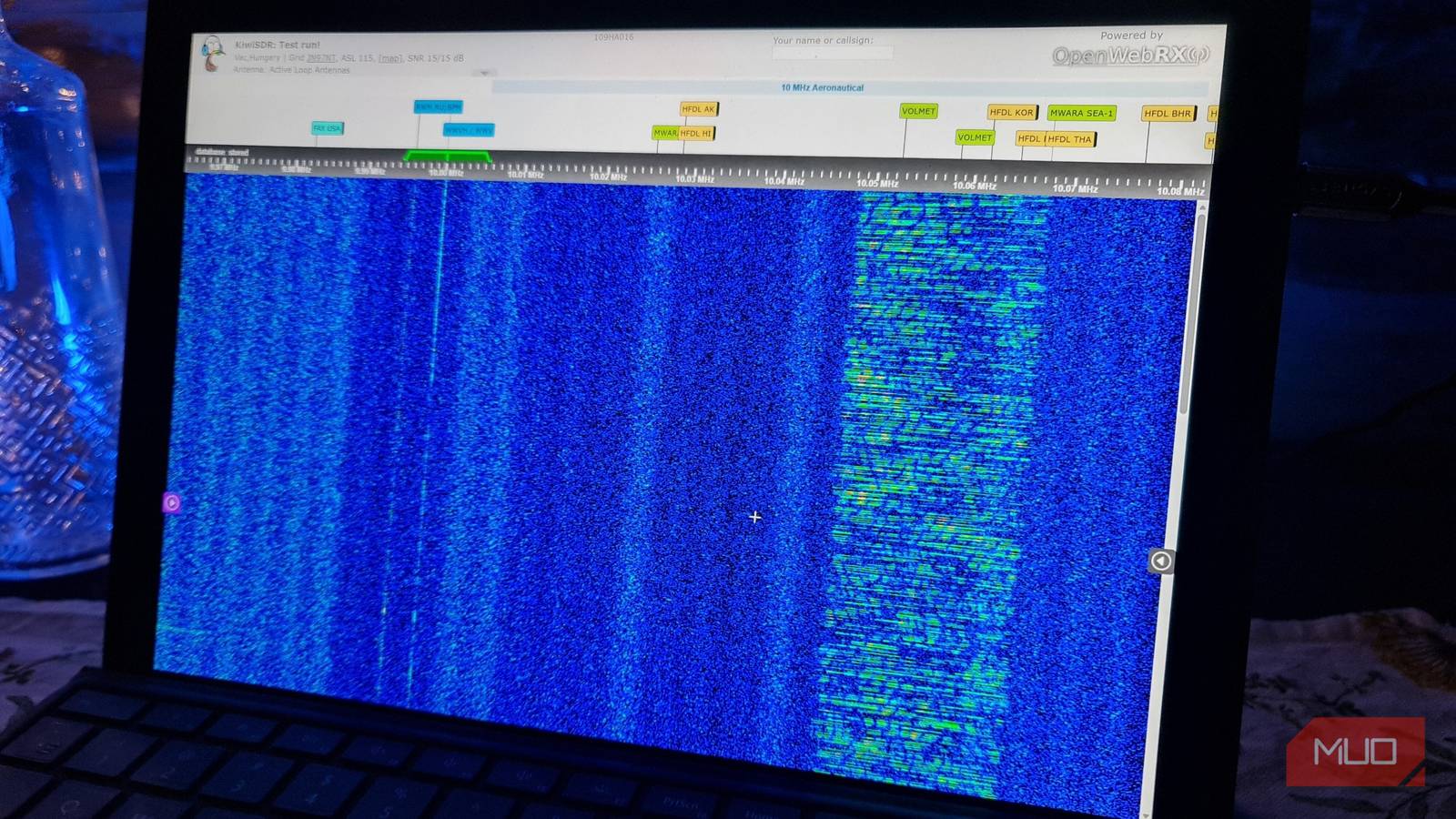
To hunt for creepy signals, start by choosing a receiver that is currently in nighttime or twilight conditions, as skywave propagation is strongest when the ionosphere is ionized but not overwhelmed. Open the waterfall display, which shows a visual spectrogram of all frequencies. Familiarize yourself with the look of common signals like time stations or utility broadcasts, then start scanning for anomalies.
UVB-76: The Buzzer
The most famous shortwave mystery is undoubtedly UVB-76, often called The Buzzer. Tune to 4625 kHz using upper sideband (USB) mode, and you will hear a repetitive, low-pitched buzz that sounds like a ship's horn. It has been transmitting since at least the 1970s, originally from a location near Moscow. The station has changed call signs several times, and occasionally the buzzing is interrupted by a male voice reading out coded messages in Russian.
The purpose of UVB-76 remains officially unknown. It is widely believed to be a Russian military communications node, possibly part of the “dead hand” system or a channel for relaying commands to nuclear forces. The internet has spun countless doomsday theories around it, with rumors that changes in the buzz pattern precede military exercises or geopolitical events. While most of these are speculation, the fact that the signal continues to be maintained by an organization that never acknowledges its existence is genuinely unsettling.
Because of its fame, many public SDRs near its suspected transmission site have blocked the frequency to prevent abuse from listeners transmitting over it or generating fake patterns. However, receivers further away, especially in Europe or North America, can often still pick it up clearly, especially at night.
Skyking: “Do not answer”
Another legendary phrase is “Skyking, Skyking, do not answer.” This is a real transmission from the United States High Frequency Global Communications System (HFGCS), a network of ground stations that provides command and control for the US military. When you hear “Skyking,” it is a high-priority encrypted message, usually an Emergency Action Message (EAM) for aircraft or missile forces. Recipients are instructed not to reply over the radio for operational security.
Listeners can tune into HFGCS frequencies such as 4724, 8992, 11175, and 15016 kHz (USB mode). Most of the time, you will hear test counts, call signs like “Mainsail,” or aircraft checking in. Skyking broadcasts are rare but have been recorded. They became internet famous around 2010 when the University of Twente WebSDR went online, giving ordinary people access to this previously obscure traffic.
The Pip, The Squeaky Wheel, and other oddities
Beyond UVB-76, there are several other mysterious repeating signals. The Pip is a series of short, repetitive tones on 5448 kHz (day) or 3756 kHz (night), also believed to be Russian military. The Squeaky Wheel is a two-tone high-pitched squeal on 5367 kHz (day) or 3363.5 kHz (night). These are often classified as “channel markers” – transmitters that continuously occupy a frequency to indicate it is reserved for a particular user.
Time stations like WWV (USA) and CHU (Canada) are less mysterious but useful for calibration. WWV broadcasts on 2.5, 5, 10, 15, and 20 MHz with AM voice announcing the time every minute. CHU can be heard on 3330, 7850, and 14670 kHz. Both provide a reliable reference for identifying genuine signals versus interference.
Number stations: coded messages from the shadows
Number stations are perhaps the creepiest category of shortwave signals. They feature calm, often female voices reading strings of numbers, letters, or code groups in a repetitive loop. The most famous active number stations include HM01 (Cuban, mixing Spanish voice with digital data bursts) and E11, also known as Oblique (English voice, scheduled broadcasts multiple times per week).
The widely accepted explanation is that these stations transmit one-time pad encrypted messages to intelligence agents operating abroad. Because the encryption key is held by the recipient, the messages cannot be decrypted without it, even if the signal is intercepted. The routine and monotony of these broadcasts – hundreds of numbers read in a flat tone – have inspired countless works of fiction and remain a favorite target for hobbyists using the Priyom.org database to track schedules.
Listening to a number station live is an eerie experience. You know that somewhere, someone might be writing down those numbers, decoding a message that could affect real-world events. The same signal is being heard by intelligence agencies around the world, but nobody outside the intended recipient can understand it. That tension between the mundane - an automated voice - and the profound - a secret communication - is what makes shortwave so compelling.
The tools you need to start exploring
To begin your own hunt, open rx-tx.info and filter for HF receivers. Choose a location with good propagation (nighttime is best). Start with well-documented frequencies: UVB-76 at 4625 kHz USB, The Pip at 5448 kHz day / 3756 kHz night, HM01 at 9330 kHz AM, and E11 at various frequencies depending on the day of the week. Use the waterfall to visually identify patterns. Number stations often appear as vertical lines of constant amplitude, while voice signals have a more irregular shape.
Websites like priyom.org provide current schedules and descriptions for active number stations. They also maintain archives of classic recordings. It is important to approach this hobby with a critical mind: many signals have perfectly mundane explanations, such as US Navy teletype or Russian air defense networks. The mystery lies not in the impossibility of identification, but in the gap between what is known publicly and what remains classified.
After spending several evenings hopping between SDRs around the world – from South Africa to Germany to California – the most striking realization is that these signals are not relics. They are live, maintained by governments or unknown entities, transmitting into the ether every day. The internet may have given us instant global communication, but shortwave remains a hidden, analog layer of the world, accessible to anyone willing to listen. The next time you tune into a weird buzz or a flat voice reading numbers, remember that you are hearing something real, something ongoing, and something that, despite all our technology, still defies a complete explanation.
Source: MakeUseOf News