

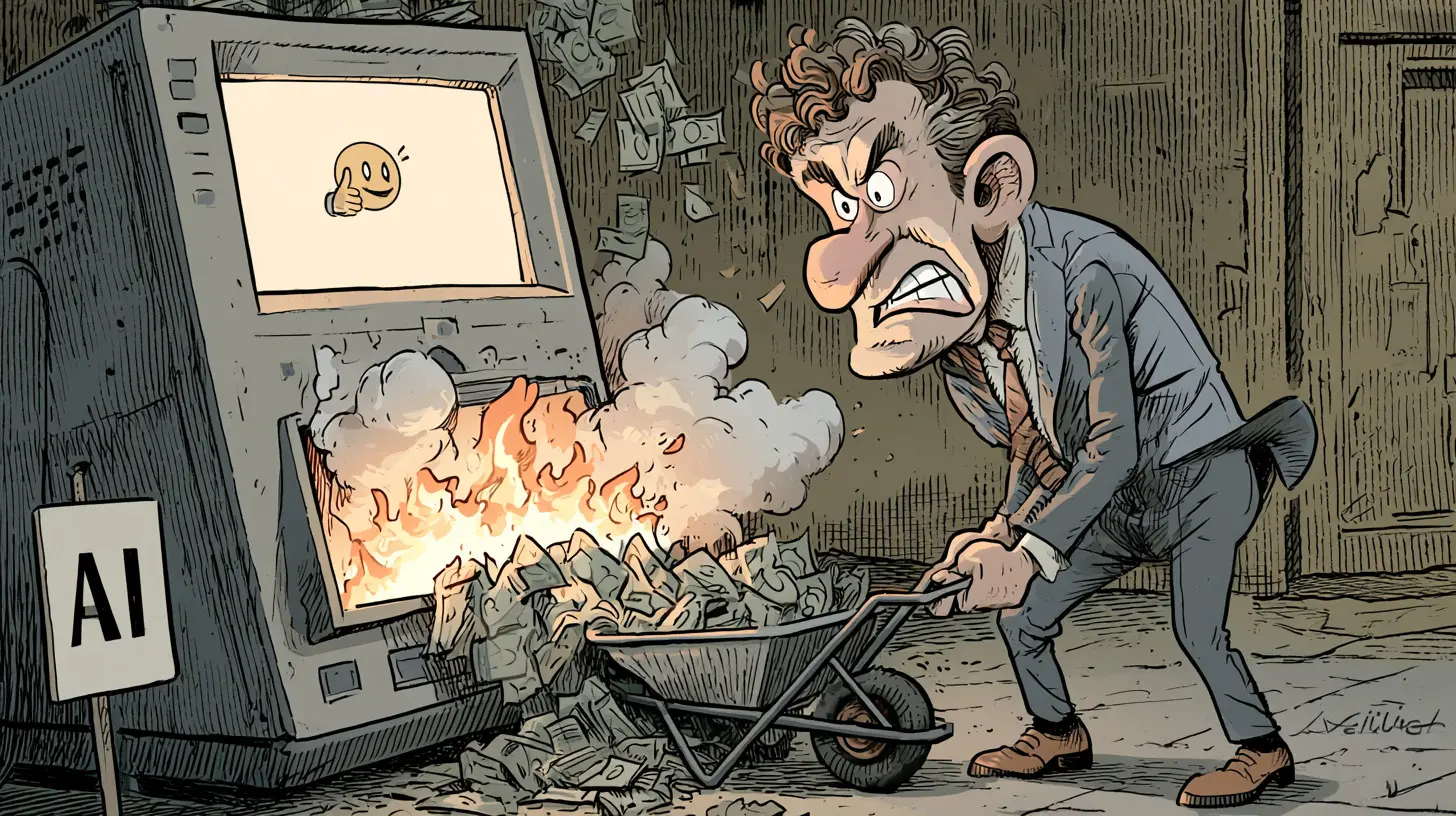
The initial promise of artificial intelligence as a cost-saving tool for enterprises is showing significant cracks. A recent incident involving an unnamed company that accidentally spent $500 million in just one month on Claude AI credits—simply because it forgot to set usage limits—has become a stark warning for the corporate world. This case underscores the financial risks of ungoverned AI adoption and adds momentum to a growing backlash from companies reevaluating the true return on investment from generative AI technologies.
The story, first reported by Axios (paywalled), reveals that the company failed to implement any guardrails on employee usage of Anthropic's Claude AI platform. Without budget caps or usage policies, workers generated an enormous volume of tokens, leading to a $500 million bill within a single month. This is the kind of scenario that makes finance departments cringe and board members demand accountability. The incident is not isolated; it follows similar reports that Uber engineers had already exhausted their entire AI budget for 2026, forcing the company to reassess its spending priorities. Corporate leaders at Costco, Delta Airlines, and IBM have publicly voiced skepticism about AI's ability to improve productivity at a reasonable cost. Uber's new COO, Andrew Macdonald, recently said that AI token usage has not translated into meaningful worker productivity gains, a sentiment that resonated widely across the internet.
This phenomenon is part of a broader pattern called "tokenmaxxing," where employees or teams burn through AI credits as quickly as possible, often without clear business justification. The mentality—encouraged by some tech vendors and early adopters—was to maximize usage to train models or explore possibilities. But as bills mount, companies are starting to ditch this approach. Even Microsoft, a company heavily invested in AI through its partnership with OpenAI, recently began canceling Claude subscriptions and discouraging employees from overusing the tool, just six months after encouraging widespread "vibe-coding" and AI experimentation. This reversal is telling: even those betting their future on AI are realizing that unlimited usage does not equate to unlimited value.
The Cost of Unchecked AI Adoption
The financial implications of AI go beyond the $500 million blunder. According to a Gartner report, inference costs for generative AI models are expected to drop to a tenth of 2025 levels by 2030. However, the same report warns that token usage could expand by 5 to 30 times over the same period, driven by more complex multi-agent systems and deeper integration into business processes. This means that even as per-unit costs decline, total spending may continue to rise sharply if usage is not managed. For many companies, the initial euphoria of AI has given way to a sobering reality: the technology is powerful, but it is also expensive and requires disciplined governance.
The shift from the early days of AI adoption—when companies were eager to invest large sums to figure out the technology—toward a more measured approach is evident across industries. Businesses are now asking tough questions: Are these tools actually making employees more productive? Is the cost of API calls justified by the output? The answer, for many, is not yet clear. The lack of clear metrics for AI ROI has led some executives to cut back on experiments and focus only on use cases with immediate, measurable returns.
Meanwhile, providers like Google and Anthropic are responding by moving toward usage-based billing models and stricter limits for non-enterprise users. This has agitated many individual users and small businesses who previously enjoyed relatively open access. The days of free or cheap AI are fading, and companies are being forced to pay for every token they consume. This is a fundamental shift from the earlier narrative that AI would dramatically lower costs; in practice, it often raises them if not carefully managed.
Historical Context: From AI Hype to Cost Reality
To understand the current cost crunch, it helps to look at the trajectory of enterprise AI adoption. When OpenAI released ChatGPT in late 2022, it sparked a gold rush. Companies scrambled to integrate AI into everything from customer service to code generation. Venture capital poured into AI startups, and tech giants invested billions in infrastructure. The assumption was that AI would automate tasks, reduce headcount, and drive efficiency. But the early returns have been mixed. While some companies have seen genuine improvements in specific areas—such as marketing copy generation or data analysis—the overall impact on productivity has been harder to measure.
A 2025 study by McKinsey found that only about half of companies that deployed generative AI reported a positive ROI within the first year. The rest either broke even or lost money. The problem is partly due to the cost of inference, which remains high for large models. Also, many employees use AI for low-value tasks that do not justify the expense. The $500 million incident is an extreme example, but it highlights a systemic issue: without proper controls, AI usage can spiral out of control.
Furthermore, the competitive landscape is shifting. As tech companies like Microsoft, Google, and Amazon continue to build out their AI offerings, they are also looking for ways to monetize them. The days of subsidized access are ending. In 2025, Anthropic introduced stricter usage tier limits for its Claude API, and Google revised its pricing structure for Gemini. These changes are forcing enterprises to think strategically about how they allocate AI resources.
Corporate Pushback and the End of Tokenmaxxing
The pushback against unrestrained AI usage is not just about costs; it also reflects a deeper skepticism about the technology's long-term value. At Costco, leaders have expressed concern that AI automation could hurt customer experience in retail settings where human touch matters. Delta Airlines has emphasized that its frontline workers are irreplaceable for complex problem-solving. IBM, long a champion of enterprise AI, has begun advocating for a more measured approach that blends human judgment with algorithmic assistance.
On the other hand, companies like Amazon, Meta, and Microsoft have been cutting jobs while simultaneously investing billions in AI infrastructure. This contradiction— replacing humans while hyping AI's cost-saving potential—has not gone unnoticed. The recent comments from Uber's COO about AI not improving productivity as expected resonated because they echoed a growing belief among workers and executives alike: the technology is often overhyped and underperforming in the real world.
The term "tokenmaxxing" has become a shorthand for the wasteful behavior of burning through credits. Companies are now actively discouraging this behavior. Microsoft's decision to cancel Claude subscriptions is a prime example. Just six months earlier, the same company had encouraged all employees to use AI coding tools and productivity assistants. The reversal indicates that the costs outweighed the benefits, or at least that the company wants to control spending until clearer value emerges.
This trend is likely to continue. According to industry analysts, we can expect more companies to implement AI governance frameworks in 2026 and beyond. These frameworks will include budget caps, usage audits, and approved use-case lists. The free-for-all era is ending, and a new era of controlled, strategic AI adoption is beginning.
What This Means for the Future of Enterprise AI
Does this mean the AI bubble is about to burst? Not necessarily. But the dream that AI would seamlessly reduce costs and increase productivity without downside is fading. Instead, companies are learning that AI is another tool that must be managed carefully, like any other business expense. The $500 million mistake is a dramatic illustration of what happens when that management is lacking.
Going forward, we can expect a more segmented AI landscape. Large enterprises will likely invest in private, on-premises AI solutions to avoid usage-based billing surprises. Others may adopt hybrid models, using public APIs only for low-risk, high-value tasks. Smaller businesses might rely on more affordable, open-source models. The market is adjusting, and the vendors that succeed will be those that offer transparency, predictable pricing, and clear ROI.
The incident also reinforces the importance of training and culture. Employees need to understand the cost implications of their AI usage. A simple lack of awareness—as in the $500 million case—can lead to staggering bills. Companies are now developing internal guidelines, similar to travel and entertainment policies, for AI spending. Some are even appointing "AI budget officers" to monitor and approve usage.
Ultimately, the initial AI fervor may not completely reverse, but it will certainly mature. The technology is too powerful to abandon, but its adoption will become more deliberate. The days of "just let everyone use it and see what happens" are over. The $500 million bill is a stark reminder that without limits, AI can cost far more than it saves.
Source: Android Authority News