

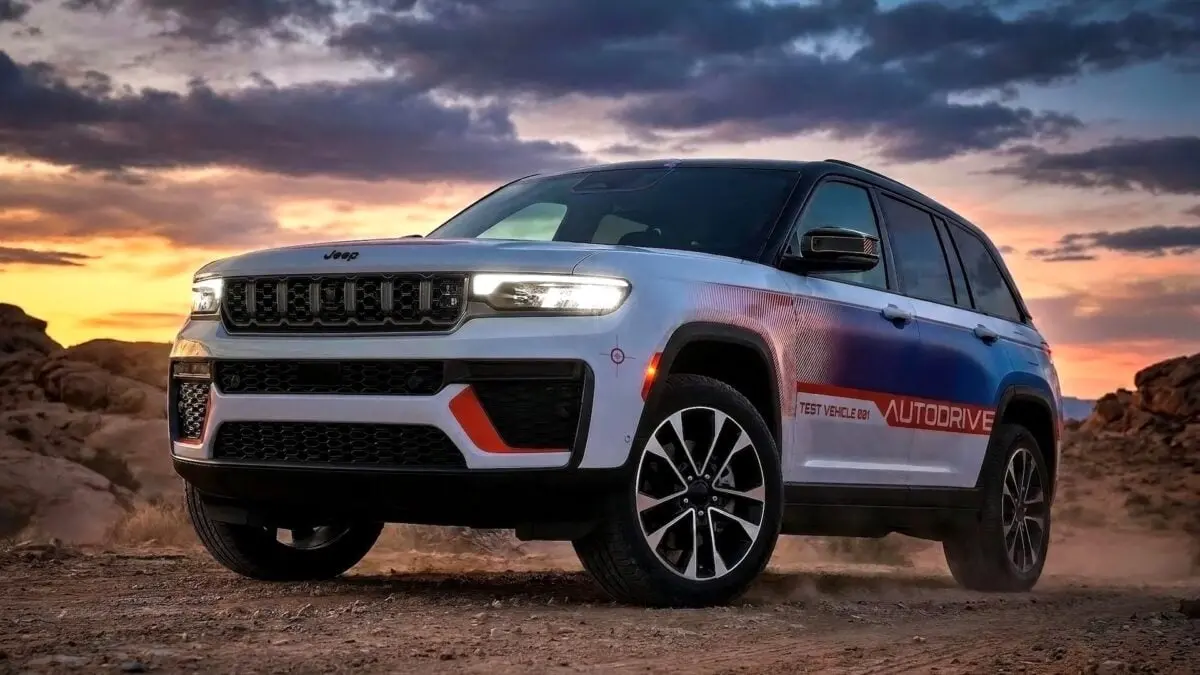
As robotaxi services steadily pop up in cities around the world, self-driving tech in commercial passenger cars has been slow to catch up. Stellantis, the parent company of Jeep, Ram, Dodge, Fiat, and several other car brands, is the latest automaker to announce plans to bring more advanced automated driving tech to its vehicles. The company announced Thursday a new strategic technology partnership with U.K.-based startup Wayve. The partnership aims to integrate Wayve's AI Driver system into Stellantis' STLA AutoDrive platform.
This collaboration could eventually equip some Stellantis vehicles with hands-free, supervised driving tech that works on both city streets and highways, similar to systems already available on Tesla and Rivian vehicles. Stellantis and Wayve are describing this first iteration as a Level 2++ system, meaning drivers would still need to pay attention to the road and supervise the vehicle as it drives. The first vehicle integration is planned for North America in 2028. Stellantis says the platform can support more advanced automated driving features down the road as regulations and customer expectations evolve.
The partnership is particularly noteworthy because of Wayve's approach to autonomous driving. Founded in 2017, the London startup makes autonomous-driving software that learns from real-world traffic using cameras and machine learning. This theoretically eliminates the need for detailed maps that its competitors rely on. Instead of building its own driverless cars, Wayve is focused on the software, which it says is vehicle-agnostic, meaning it can be adapted to work on everything from passenger cars to delivery vans.
Wayve's technology uses a deep learning architecture it calls the Wayve AI Driver, which processes visual data from cameras and learns to drive through observation and experience, similar to how a human driver learns. The company uses reinforcement learning and simulation to train its AI, allowing it to handle complex and unpredictable driving scenarios without the need for extensive mapping or hand-coded rules. This approach is seen as more scalable and adaptable compared to traditional autonomous driving systems that rely on high-definition maps and lidar sensors, which can be expensive and difficult to maintain at scale.
Stellantis' STLA AutoDrive platform is the automaker's own automated driving system, which it has been developing for several years. The platform is designed to support a range of driving automation levels, from Level 2 driver assistance to Level 4 fully autonomous driving. By integrating Wayve's AI Driver, Stellantis aims to accelerate the development and deployment of advanced driver assistance features across its broad portfolio of brands, which includes not only Jeep, Ram, and Dodge but also Chrysler, Fiat, Alfa Romeo, Maserati, and Peugeot among others.
While there is no word yet on which specific brands or models would get the tech first, Wayve developed a prototype with Stellantis in just a few weeks on the company's Jeep Cherokee platform. This rapid integration demonstrates the flexibility of Wayve's software and the potential for quick deployment across Stellantis' vehicle lineup. The prototype was reported to be operational in less than two months, a timeline that underscores the agility of Wayve's technology compared to traditional autonomous driving development cycles, which often take years.
The buzzy startup announced earlier this year that it had closed a $1.2 billion Series D investment round with a range of investors, including SoftBank, Microsoft, Nvidia, and Uber. And just last month, Advanced Micro Devices, Arm, and Qualcomm Ventures announced a separate $60 million investment in the company. This high level of investment from some of the biggest names in technology and automotive reflects confidence in Wayve's vision and technical approach. Uber's investment will specifically support Wayve-powered robotaxis on the Uber platform. The companies intend to launch their first service in London in 2026, with plans to expand across multiple markets.
Nissan has also signed on to use Wayve's technology. In December 2025, the automaker announced that it would integrate Wayve's tech into a broad range of its cars starting in 2027. This partnership positions Wayve as a key player in the race to bring autonomous driving to consumer vehicles, alongside other companies like Mobileye, Qualcomm, and Tesla. The company's ability to attract both traditional automakers and tech giants speaks to the promise of its AI-first approach.
The autonomous driving industry has seen significant shifts in recent years. Many companies that once promised fully autonomous vehicles by 2020 have since scaled back their ambitions, focusing instead on more achievable goals like driver assistance features. Wayve's approach, which starts with Level 2++ and plans to progress to higher levels, aligns with this pragmatic industry trend. The company's system is designed to be continuously updated over the air, allowing vehicles to improve their driving capabilities over time as the AI learns from more data and experience.
For Stellantis, the partnership is part of a broader strategy to compete in the rapidly evolving automotive technology landscape. The company has been investing heavily in electrification and software-defined vehicles under its Dare Forward 2030 strategic plan. By partnering with Wayve, Stellantis gains access to cutting-edge autonomous driving technology without having to develop it entirely in-house, potentially speeding up time-to-market and reducing development costs. The automaker has also been exploring other autonomous driving partnerships, including a deal with BMW for Level 3 highway driving.
The integration of Wayve's technology into Stellantis vehicles is expected to begin with the 2028 model year for the North American market. The system will initially offer hands-free driving on highways and city streets, with the driver required to remain attentive and ready to take control at any time. Over time, Stellantis says it will introduce more advanced features as the technology matures and regulations allow. The company is also considering extending the technology to other markets, including Europe and Asia.
The autonomous driving technology landscape is often categorized by the Society of Automotive Engineers (SAE) levels, from Level 0 (no automation) to Level 5 (full automation). Level 2 systems provide partial automation, with the vehicle controlling both steering and acceleration/deceleration, but the driver must monitor the driving environment at all times. Level 3 systems allow the driver to disengage from driving under certain conditions, but must be ready to take over when requested. Level 4 systems can handle all driving tasks in specific conditions or geographic areas, while Level 5 systems are fully autonomous in all conditions. Wayve's Level 2++ designation represents a premium level of driver assistance that approaches the capabilities of Level 3 without the full legal responsibility shift.
Wayve's technology has been tested on public roads in the UK and other countries, accumulating millions of miles of driving data. The company has a fleet of test vehicles in London and has demonstrated its system's ability to handle complex urban environments, including roundabouts, pedestrian crossings, and construction zones. The company emphasizes safety and has published research on its approach to robust perception and decision-making using machine learning.
The partnership with Stellantis is expected to accelerate Wayve's commercialization, providing the startup with a significant production volume and a pathway to widespread deployment. Stellantis sold over 6 million vehicles globally in 2025, offering a massive potential market for Wayve's technology. The automaker's diverse brand portfolio and global manufacturing footprint could help Wayve scale its technology across different vehicle types and regions.
In addition to the technical aspects, the partnership also involves a financial arrangement. While the terms were not disclosed, such agreements typically include upfront payments, royalties per vehicle, and possibly equity stakes. Wayve's financial backing from major investors gives it the resources to support the integration work with Stellantis. The company also plans to expand its workforce, hiring engineers and researchers in both the UK and the US to support the Stellantis partnership and other customers.
The announcement of the Stellantis partnership comes at a time when the automotive industry is increasingly adopting a collaborative approach to autonomous driving technology. Rather than each automaker developing its own system from scratch, many are turning to specialized technology providers like Wayve, Mobileye, or Qualcomm to leverage their expertise and economies of scale. This trend is similar to what happened in the smartphone industry, where companies like Qualcomm provide chips and software that enable a wide range of devices.
The potential impact on consumers is significant. Stellantis' brands, especially Jeep, Ram, and Dodge, are popular among North American buyers, many of whom have not had access to advanced driver assistance systems beyond basic adaptive cruise control and lane-keeping. The addition of hands-free driving on highways and city streets could enhance convenience and safety, potentially reducing driver fatigue and accident risk. However, the Level 2++ system still requires the driver to remain engaged and attentive, meaning it is not a substitute for full autonomous driving.
In the longer term, Stellantis and Wayve are exploring the possibility of upgrading the system to support Level 3 and ultimately Level 4 automation, which would allow the driver to disengage from driving in certain conditions. Such upgrades would likely require regulatory approval and further technical development. The companies say their platform is designed to be scalable and adaptable to future advancements in sensors, computing power, and AI algorithms.
The partnership also has implications for the broader autonomous driving ecosystem. Wayve's success in attracting multiple automaker partners could help standardize its technology across the industry, potentially creating a unified platform that makes it easier for developers to build applications and services on top of autonomous driving capabilities. The company has already shown interest in expanding beyond passenger cars into areas like logistics and delivery, where its vehicle-agnostic software can be applied to vans and trucks.
In conclusion, the Stellantis-Wayve partnership represents a significant step forward in bringing advanced autonomous driving technology to mass-market vehicles. With a clear timeline for deployment in 2028, the collaboration has the potential to make hands-free driving accessible to millions of new drivers, while laying the groundwork for even more advanced automation in the future.
Source: Gizmodo News