

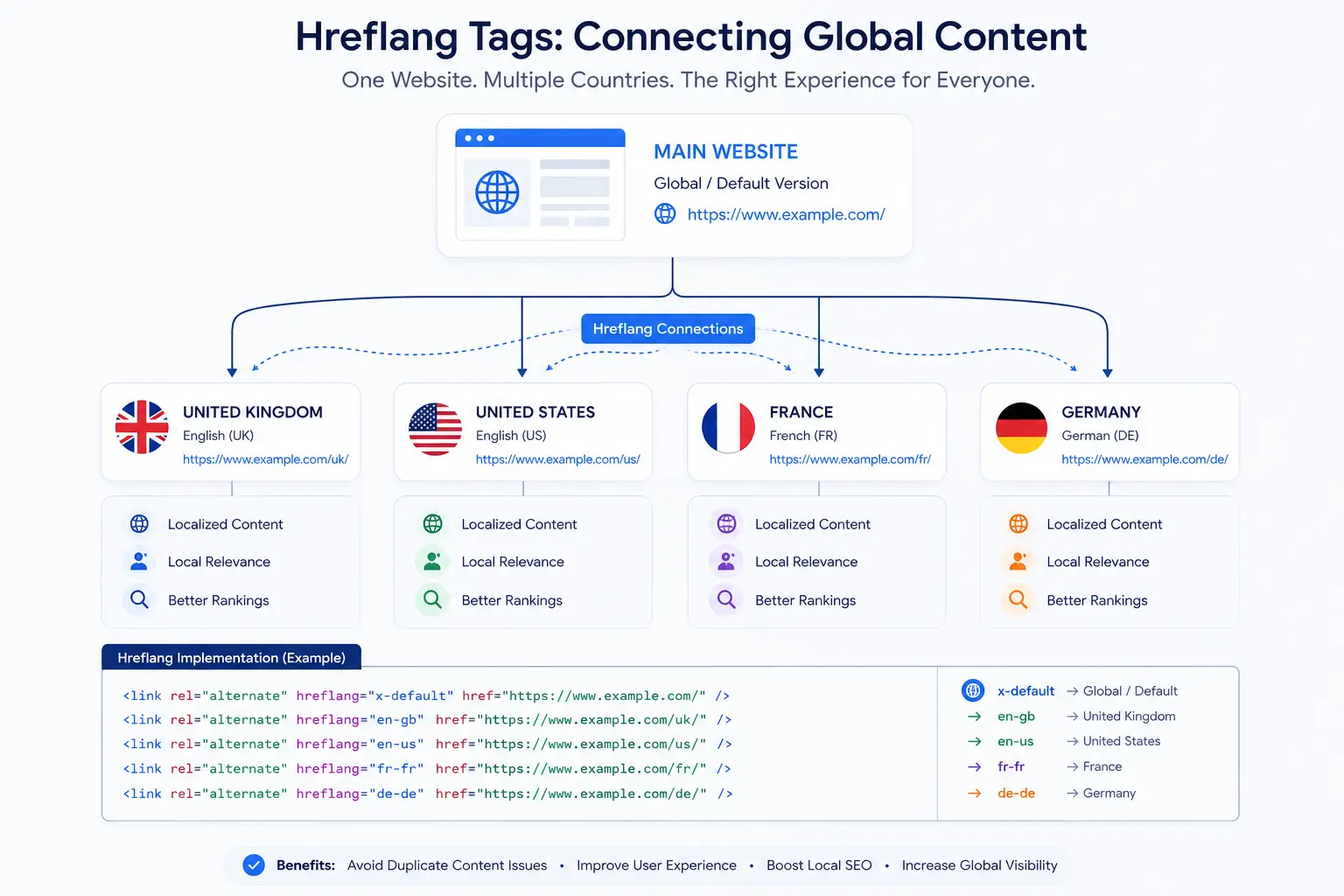
To succeed in international SEO, you must combine technical URL structures (like subfolders or ccTLDs) with deep content localization and Hreflang implementation. It isn't just about translating words; it's about signaling to search engines exactly which version of your site belongs to which specific region or language.
TL;DR: How to Target Multiple Countries
To rank globally, choose a URL structure (subfolders are usually best), use Hreflang tags to prevent duplicate content issues, and localizing your content beyond simple translation. Focus on building regional authority through high-quality links and understanding local search intent rather than just mirroring your home-market strategy.
I’ve been in the SEO trenches for over a decade, and if there's one thing I can tell you for free, it's that "Global SEO" is a bit of a misnomer. You aren't ranking "globally"; you're ranking in dozens of individual, local markets simultaneously. Most marketing managers think they can just flip a switch on a translation plugin and watch the traffic roll in. Here is the thing: it doesn't work like that. If you want real growth, you need a strategy for International SEO for Multiple Country Targeting that accounts for cultural nuances and technical precision.
What is International SEO and How Does It Work?
International SEO is the process of optimizing your website so that search engines can easily identify which countries you want to target and which languages you use for business.
It’s essentially a roadmap for Google. Without it, your UK users might end up on your US pricing page, or your Brazilian audience might see European Portuguese. This confusion leads to high bounce rates and lost conversions. By using specific signals like Hreflang attributes, localized keyword research, and regional server locations, you tell the algorithm, "This specific content is for this specific person in this specific place."
Why International SEO Matters in 2026
By 2026, the search environment has shifted toward hyper-personalization. AI-driven search engines are getting better at detecting "cultural fakes." If your site feels like it was translated by a machine and doesn't offer local payment methods or address local pain points, you'll lose your ranking to a local competitor every time.
What most people overlook is that international SEO is now a prerequisite for brand safety. In a world where AI-generated content is everywhere, demonstrating a physical or cultural presence in a specific market is a massive trust signal. It's no longer just about traffic; it's about proving you are a legitimate entity within that border.
How to Set Up International SEO — Step by Step
- Choose Your URL Structure You have three main paths: ccTLDs (example.de), subdomains (de.example.com), or subfolders (example.com/de/). In my experience, subfolders are the way to go for most SMB owners. They allow you to consolidate your "domain authority" into one place rather than spreading it thin across multiple sites. It makes your Guest Posting Services and backlink efforts much more effective since the link juice stays under one roof.
- Mapping Your Hreflang Tags This is the technical "glue" of international SEO. You need to add code to your header or sitemap that tells Google: "If the user is in France, show them the /fr/ page." Be careful here—one small typo in your language codes can break your entire international visibility.
- Localized Keyword Research Never use a direct translation of your primary keywords. A "sweater" in the US is a "jumper" in the UK. If you're looking for Guest Post Backlinks in Australia, you might find the terminology slightly different than in Canada. Use local tools to see what people actually type into their search bars.
- Audit Your Content for Cultural Relevance I once saw a brand try to launch a "Summer Sale" in Australia during June. It was a disaster. Why? Because it’s winter there. You need to check your imagery, your metaphors, and your seasonal offers.
- Build Local Authority You need links from sites within your target country. If you want to rank in Germany, a bunch of .com links won't move the needle as much as a few solid .de links. This is where High DA Guest Posting becomes your best friend.
The Counterintuitive Truth: You Don't Always Need to Translate
Here is my "hot take" that might annoy some purists: You don't always need to translate your site to target a new country.
I’ve seen plenty of tech companies successfully target the Nordic markets or the Netherlands using English-language content. In these regions, English proficiency is so high that users often search in English for professional services. Instead of spending $50,000 on a mediocre translation, they spent that budget on Guest Post Outreach and High Authority Backlinks to dominate the English-language search results in those specific regions. Sometimes, being the best English-language resource in a non-English speaking country is a faster path to ROI than being a "decent" local-language resource.
Expert Tips: What Actually Works
Let me be direct: technical SEO gets you through the door, but link building keeps you in the room. When you're expanding into new territories, you start with zero local "trust."
You'll probably want to work with a Guest Post Agency that understands the local landscape. I've found that Manual Outreach Guest Posting is the only way to get those "gold nugget" links that actually move the rankings. Don't fall for the cheap lists; you want Premium Guest Posting Sites that have real traffic.
Expert Tip: Always prioritize your "money pages" for localization first. Don't try to translate your entire 500-post blog at once. Start with your service pages and your top three most popular articles. Once you see a bit of traction in the local Search Console, then you can scale.
Best Press Release Submission Platforms for SEO & Brand Visibility
When you are breaking into a new country, you need to make a splash. Utilizing press release distribution sites is a powerful way to gain immediate visibility and build a foundation of trust. An effective press release agency doesn't just send out a wall of text; they craft a narrative that local journalists actually want to cover.
The beauty of using PR submission sites lies in the diversity of the link profile they provide. While news distribution platforms offer high-velocity mentions, they also provide online PR marketing benefits that signal to Google your brand is currently "trending" or newsworthy. This spike in brand searches can often trigger a faster indexing of your new international subfolders.
When you combine Guest Posting for SEO with a strategic PR blast, you are attacking the rankings from two sides: long-term authority and short-term relevance. It’s a one-two punch that makes your international expansion feel like an event rather than just a quiet update.
People Most Asked about International SEO
How do I target a specific country without a local domain?
You can use the "International Targeting" report in the old Google Search Console (though it's being phased out) or, more reliably, use subfolders with correct Hreflang tags. This tells Google your /uk/ folder is specifically for the United Kingdom.
Is Hreflang really that important?
Yes, it's the difference between being seen as a global authority or a duplicate content spammer. Without it, Google might see your US and UK pages as identical and choose to index only one, effectively hiding you from one of those markets.
Should I use Google Translate for my international site?
In most cases, no. While it's gotten better, it still misses slang, tone, and industry-specific jargon. Use it as a base if you must, but always have a human editor who understands White Hat Guest Posting and local terminology review the final copy.
Does server location still matter for SEO?
It's a minor factor compared to what it used to be, thanks to CDNs (Content Delivery Networks). However, having a server (or a CDN node) close to your users improves site speed, which is a significant ranking factor.
Can I target multiple countries with one page?
You can target multiple countries that speak the same language (like a general "Spanish for Latin America" page), but you'll always perform better with a dedicated page for each country to account for local currency, shipping, and specific terminology.
How to Scale Your Link Building Internationally
Once your technical foundation is set, you need to Buy Guest Posts that are relevant to your niche in that specific region. Look for Niche Guest Posts where the audience is already interested in what you do. For example, if you sell software in France, getting a link from a French tech blog is worth ten links from a generic US "mommy blog."
The goal is to build Dofollow Guest Posts that pass real authority. This isn't just about the link; it's about the referral traffic. If real people in Germany are clicking a link to your site, Google notices that engagement and rewards you accordingly.