

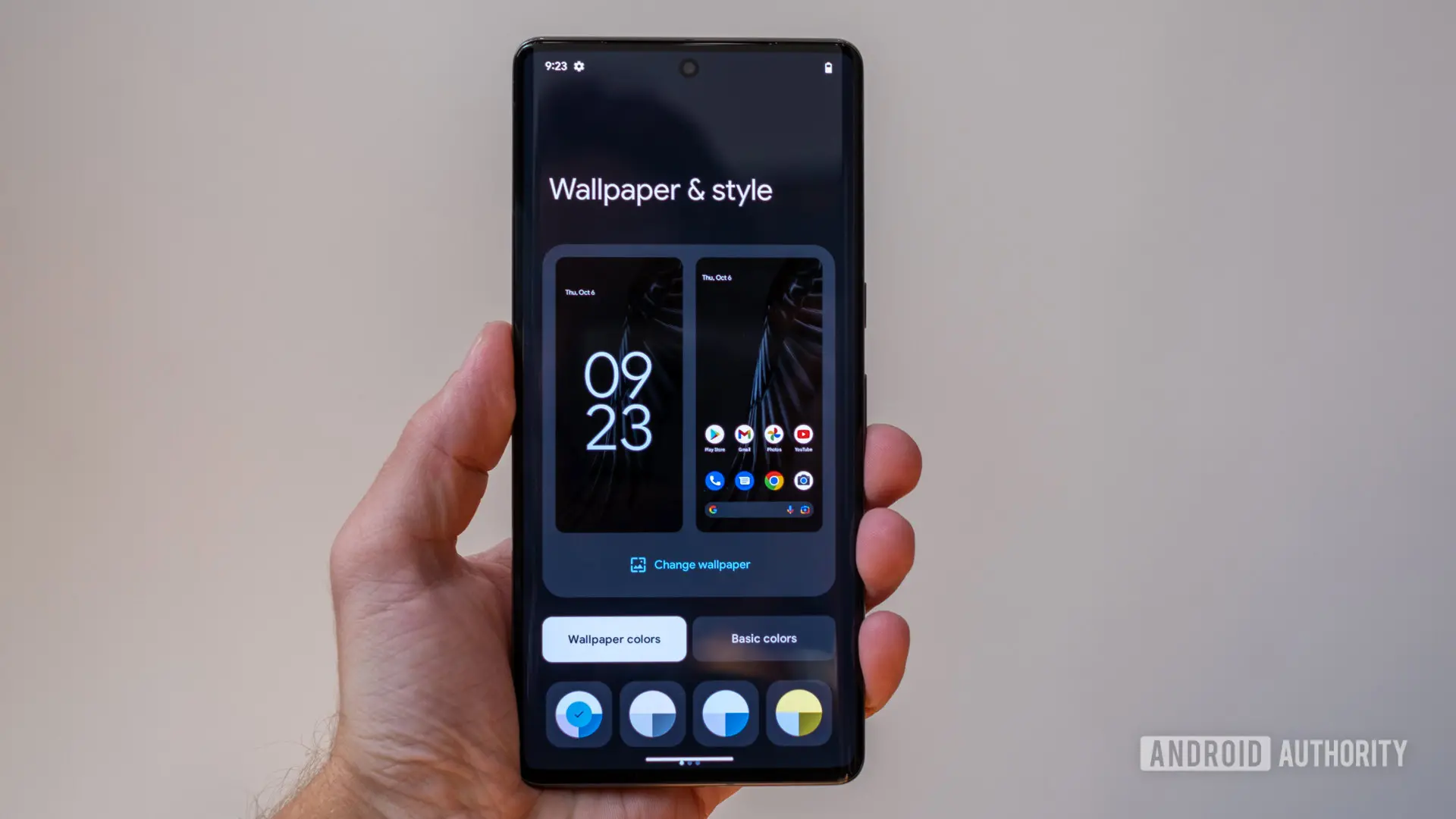
Google's Material You design language has been a hallmark of the Pixel experience since Android 12 launched in 2021. The system automatically generates a color palette based on your wallpaper, applying those hues to system UI elements like icons, buttons, menus, text highlights, and Quick Settings tiles. However, users have long lamented the lack of granular control—you can only choose from a handful of preset palettes, not define your own exact shade.
A new leak suggests this is finally about to change. Video footage shared by Telegram leakers Mystic Leaks, who reportedly obtained an early build of a future Android 17 release, shows two significant upgrades coming to the Wallpaper & style settings on Pixel devices. The first is a set of color intensity presets: Neutral, Soft, Bright, and Bold. The second—and far more requested—is a full color picker with sliders that let users manually choose their own accent color.
What the leak shows
In the leaked video, users can see the new color intensity options. Neutral appears to desaturate the interface heavily, using gray shades. Soft keeps colors subtle and muted. Bright makes the interface more vibrant, while Bold applies stronger multi-color accents across the UI. These presets give users broad control over how prominent the Material You color scheme is in their daily use.
More exciting is the custom color picker. A standard color wheel or slider interface appears, allowing users to select any hue. As they adjust the slider, Android previews the changes in real time on the home screen and system UI. This level of freedom has been requested since the feature debuted, but Google has resisted adding it—possibly to maintain a consistent visual identity or to avoid overwhelming average users.
Background: Material You's evolution
Material You (also known as Material Design 3) was announced at Google I/O 2021 and rolled out with Android 12. It introduced dynamic color theming using a system called Monet. Monet extracts dominant and accent colors from the wallpaper and generates a palette of up to five colors (primary, secondary, tertiary, neutral, and neutral variant). These colors are then applied system-wide, from notification shade to Settings apps and even third-party apps that adopt the theming API.
However, the customization was always limited. Users could pick from 4-6 suggested palettes based on the wallpaper, or tap “Other colors” to see a grid of predefined swatches. There was no way to enter a hex code, use a slider, or fine-tune shades. For a company that prides itself on personalization, this was a notable gap. Apple’s iOS 14 introduced color tinting for widgets and later expanded system-wide color adjustments, but Google’s approach remained more rigid.
Pixel users have voiced their desires on forums, Reddit, and Google’s Issue Tracker for years. A popular feature request titled “Allow users to set custom accent colors” has accumulated thousands of upvotes. With this leak, it appears Google is finally listening.
How the new feature might work
Based on the leaked video, the new color intensity presets will appear in the same Wallpaper & style menu just below the color palette section. Users can toggle between Neutral, Soft, Bright, and Bold. Each preset likely adjusts the saturation and brightness mapping of the existing palette, rather than changing the base colors themselves.
The custom color slider, meanwhile, appears to be a separate panel. It allows you to pick a hue by dragging a slider or tapping on a color wheel. Once selected, Android will generate a full five-color palette based on that manually chosen accent color, similar to how it extracts colors from a wallpaper. This means the system will still create complementary shades, but the user has direct control over the primary accent.
Implications for developers and designers
If these features ship, they will have implications for app developers who use Material You theming. Currently, developers can signal that their app should use dynamic colors by setting android:colorPrimary, android:colorSecondary, etc., to @android:color/system_accent_. These resources adapt based on the user's palette. With custom colors, apps should automatically pick up the chosen accent color without any code changes—the system handles the mapping.
However, designers who rely on specific contrast ratios may need to test their apps with more extreme custom colors. A user could choose a very light yellow accent that fails accessibility guidelines on white backgrounds. Google might implement safeguards, such as automatically adjusting the shade to meet contrast requirements or offering a warning.
Release timeline and speculation
It remains unclear when these features will reach stable Pixels. The leak is based on an early build of Android 17, which is expected to be released as a stable version in late 2025 (likely with the Pixel 10 series). However, the leaked video shows functionality that current Android 17 Developer Previews do not include. Google often reserves major user-facing changes for quarterly platform updates (QPRs) after the initial release. For example, Android 14 QPR2 introduced lock screen customization, and Android 15 QPR1 added new charging indicators.
Therefore, it is plausible that the custom color controls will debut in Android 17 QPR1, which would arrive a few months after the stable Android 17 launch. Alternatively, they could be part of a later Pixel Feature Drop, as Google has increasingly decoupled some updates from the main Android version.
Some speculate that Google may also introduce system-wide blur effects seen in the same leak, adding a new layer of visual polish to the Pixel experience. Blur has been used sparingly in Android (e.g., in the notification shade background), but a more consistent implementation could align with Apple’s and Samsung’s designs.
How this fits Google's strategy
Google has been investing heavily in on-device AI and customization. Pixel phones are the only Android devices that offer a truly integrated software experience, with features like Call Screen, Now Playing, and the Pixel Camera. By enhancing Material You, Google distinguishes Pixels from other Android phones that often skin the OS heavily. Stock Android (as seen on the Pixel) has gained a reputation for being clean but barebones in customization compared to One UI or ColorOS. Adding custom color controls narrows that gap while still maintaining the core Material You philosophy.
Furthermore, the move aligns with the broader trend of user agency—allowing people to tailor their devices to their taste. In an era where phones look increasingly similar, personalization is a key selling point. Google is also working on more AI-driven features like generative wallpapers, which could pair nicely with these new color options.
What remains unchanged
It's important to note that the current preview does not show any changes to other parts of the theming system. Themed icons—which allow third-party app icons to adopt the accent color—will likely remain in their current form. Similarly, the automatic palette generation from wallpapers will still be the default behavior. The custom sliders are an optional override, not a replacement for the existing system.
Users who prefer simplicity can continue using the preset palettes. The new intensity presets (Neutral, Soft, Bright, Bold) will likely be available regardless of whether the user picks a preset color or a custom one. This layering of options gives both casual and power users the tools they want.
Summary of key facts from the leak
- Leaked video from Mystic Leaks shows new Wallpaper & style features in an early Android 17 build.
- Custom accent color slider allows manual selection of any hue, with real-time preview.
- Four new intensity presets: Neutral (gray tones), Soft (subtle), Bright (vibrant), Bold (strong multi-color).
- Features not present in current Android 17 Developer Preview builds, suggesting a later release.
- May debut with Android 17 QPR1 or a Pixel Feature Drop.
- Would address long-standing user requests for deeper Material You customization since Android 12.
Source: Android Authority News