

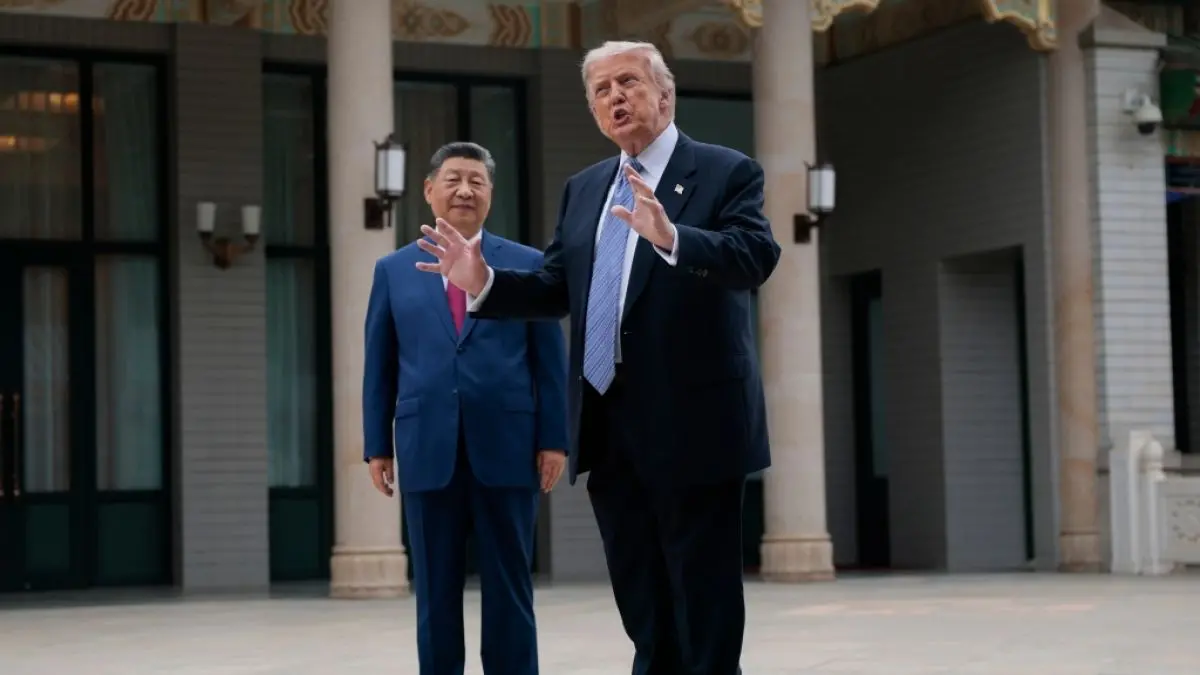
US President Donald Trump has once again made headlines with his unconventional diplomatic language, this time during an interview with Fox News host Sean Hannity. Trump singled out Chinese President Xi Jinping for lavish praise, describing him as 'like from a picture book' for a Chinese leader. The comments, which focused heavily on Xi's physical appearance and leadership style, have since sparked a firestorm on social media platforms, drawing accusations of racism and mockery.
Key Facts from Trump's Interview
Trump's remarks were part of a broader conversation about his relationships with world leaders. According to transcripts of the interview broadcast on May 15, 2026, Trump said that if you went to Hollywood looking for an actor to play the leader of China, Xi would be 'central casting.' He elaborated that Xi's physical features are particularly striking, stating, 'He is tall, very tall, especially for this country, because they tend to be somewhat smaller.' The President also described Xi as a warm-hearted person who is entirely focused on business, adding that Xi 'doesn't play games' and that there is no small talk about weather or stars, only factual discussions.
Background on Trump's Praise of Xi
This is not the first time Trump has expressed admiration for Xi Jinping. During his first term, Trump often highlighted his 'great relationship' with the Chinese leader, despite ongoing trade disputes and geopolitical tensions. However, the focus on Xi's physique has drawn particular criticism. Experts note that Trump's use of the term 'central casting' originates from a Hollywood agency founded in 1925 that supplied extras for films and television. In modern parlance, it means someone perfectly suited for a role. But critics argue that reducing a world leader to his physical attributes, especially in the context of racial stereotypes, is deeply problematic.
The timing of the interview also matters. It comes amid heightened tensions between the US and China over issues such as technology, human rights, and military posturing in the South China Sea. Trump's effusive praise of Xi may be seen as out of step with the confrontational stance his administration has taken in other areas.
Social Media Reactions
Platform X, formerly Twitter, erupted with reactions within minutes of the interview airing. Many users accused Trump of making racist statements. One user wrote, 'Make racist comments great again. Every damn day.' Another commented, 'His stupidity is breathtaking. How the hell did we end up here?' Some observers focused on Trump's apparent preoccupation with male bodies, noting that he has recently made several comments about the physical appearance of other male political figures. 'Trump talks a lot about men's bodies lately. Just saying,' remarked one user. Others expressed sympathy for the interviewer, Hannity, who had to maintain a straight face while Trump 'rambled on.'
The controversy also revived broader debates about Trump's relationship with authoritarian leaders. Critics argue that Trump's admiration for strongmen like Xi, Vladimir Putin, and Kim Jong Un reflects a fascination with power and control rather than democratic values.
Analysis of Trump's Rhetoric
Political analysts point out that Trump's language often reflects his background in entertainment and branding. The phrase 'like from a picture book' (in German, 'wie aus dem Bilderbuch') is a direct translation of a common German expression meaning 'ideal' or 'perfect.' Trump's use of such vivid imagery is characteristic of his communication style, which relies on simple, memorable phrases. However, when applied to a foreign leader, especially one from a different racial background, those phrases can carry unintended connotations of exoticism or stereotyping.
The reference to height is particularly loaded. Studies have shown that height is often associated with leadership qualities, but noting that Xi is tall 'especially for this country' reinforces a stereotype about the average height of Chinese people. While statistically, average height varies across populations, singling out Xi's height relative to his compatriots can be seen as reducing a complex individual to a physical trait.
Furthermore, Trump's comments about Xi being 'warm-hearted' but 'focused on business' suggest a transactional view of diplomacy. Trump has often expressed admiration for leaders who are pragmatic and decisive, regardless of their political systems. This has led to accusations that Trump is too soft on autocratic regimes.
Historical Context of US-China Relations
The interview also reignited discussion about the state of US-China relations under Trump. During his previous term, Trump initiated a trade war with China, imposing tariffs and driving a wedge between the two largest economies. Yet he also publicly praised Xi, creating a confusing dynamic. Some analysts believe that Trump's praise serves as a negotiating tactic, while others see it as genuine admiration.
China's official media initially did not report extensively on Trump's remarks, but the comments were widely circulated on Chinese social media platforms like Weibo, where many users expressed amusement or skepticism. Some Chinese netizens speculated that Trump's praise could be a prelude to a new trade deal, while others dismissed it as typical Trump exaggeration.
The controversy also highlights the role of media in shaping public perception. Fox News, the channel that broadcast the interview, is known for its conservative lean and support of Trump. Hannity, the interviewer, did not challenge Trump's comments, which led some critics to accuse the network of enabling inflammatory rhetoric.
Broader Implications
Trump's remarks come at a time when he is facing multiple legal challenges and a potential reelection campaign. His media appearances are closely scrutinized for any signs of declining cognitive ability or inappropriate behavior. In this context, the Xi comments could be seen as another example of Trump's unfiltered style, which energizes his base but alienates moderates.
International reactions have been mixed. Some European leaders declined to comment, but former diplomats expressed concern that Trump's casual racism undermines American soft power. Human rights organizations also condemned the comments, arguing that they normalize stereotyping of Asian people.
As the story continues to develop, it serves as a reminder of the power of presidential rhetoric. A few sentences from the US President can dominate headlines for days and shape global perceptions. Whether Trump intended to cause controversy or simply spoke off the cuff, the fallout is likely to persist.
Related Developments
In related news, Trump has recently faced scrutiny over his health, with some doctors and observers calling for his removal under the 25th Amendment. Additionally, Vice President JD Vance has been mocked for an awkward speech praising Trump. These stories, along with the Xi controversy, paint a picture of an administration constantly embroiled in public relations crises.
Ultimately, Trump's characterization of Xi Jinping as 'picture perfect' may be remembered less for its diplomatic substance and more for the debate it sparked about race, leadership, and the appropriate boundaries of presidential discourse. As social media continues to amplify every utterance from world leaders, the line between statesmanship and spectacle grows ever thinner.
Source: News.de News