

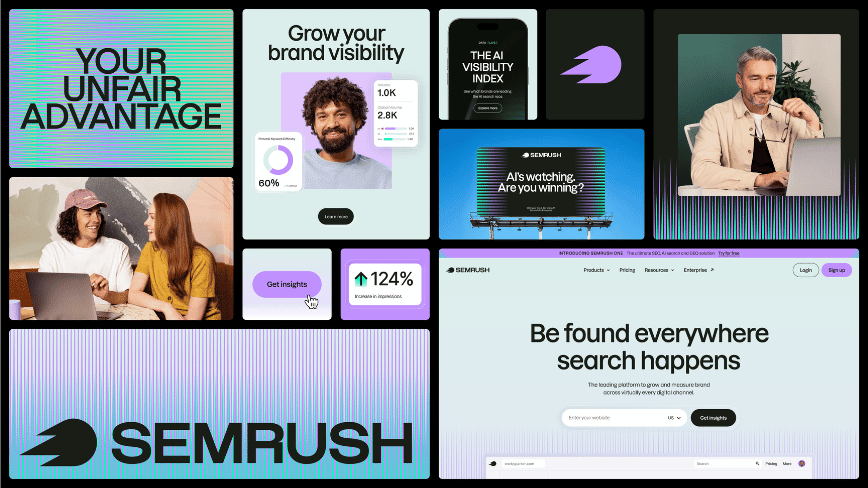
Summary: Semrush launched a Brand Visibility Framework at Adobe Summit, introducing 'Agentic Search Optimisation' as a new discipline for measuring brand presence across AI-generated answers, traditional search, and autonomous AI agents, drawing on 213 million LLM prompts. The framework arrives as organic click-through rates have dropped 61% on queries with AI Overviews, 62% of brands are invisible to generative AI, and Semrush’s own AI product revenue has grown 850% to $38 million ARR, all while the company awaits completion of its $1.9 billion acquisition by Adobe.
Semrush utilized its platform at Adobe Summit in Las Vegas to unveil its innovative Brand Visibility Framework, a strategic model designed to measure how brands are discovered within traditional search engines, AI-generated answers, and autonomous AI agents. This framework introduces the concept of 'Agentic Search Optimisation' as a new operational discipline, leveraging a database of over 213 million large language model prompts to provide brands with insights into how they are discussed, recommended, or overlooked within systems where human clicks are no longer the primary interaction.
The timing of this launch is crucial. Semrush is in the midst of a $1.9 billion acquisition by Adobe, a deal first announced in November 2025, which is expected to finalize in the first half of this year. This framework positions Semrush as a critical visibility layer within Adobe’s marketing ecosystem during a time when AI is fundamentally altering brand visibility dynamics.
The Challenges Addressed by the Framework
The data supporting this framework presents a grim outlook for businesses reliant on organic search traffic. Gartner predicted in February 2024 a 25% decline in traditional search engine volume by 2026, primarily due to the rise of AI chatbots and virtual agents. This prediction is manifesting as Google’s AI Overviews now appear on 48% of monitored search queries, reflecting a 58% year-over-year increase, and on 80 to 88% of informational queries, varying by industry. Additionally, organic click-through rates have plummeted by 61% for queries featuring AI Overviews, according to Seer Interactive, while paid search click-through rates fell dramatically from approximately 11% to just 3% within a single month last year.
Zero-click searches, where users receive answers without visiting any websites, surged from 56% to 69% of all queries from May 2024 to May 2025. ChatGPT now boasts 800 million weekly active users, and Perplexity processed 780 million queries in May 2025 alone. Although traffic originating from AI search converts at a rate of 14.2%, compared to just 2.8% from conventional Google search, the volume of this traffic remains significantly lower, leaving brands with minimal control over their visibility in AI systems.
The most striking revelation from the accompanying research is the disparity between investment in SEO and actual visibility. While 94% of brands invest heavily in traditional SEO, Semrush found that 62% are 'technically invisible' to generative AI models. Only 8 to 12% of the results appearing in AI-generated answers overlap with those that rank well in traditional search. Notably, ChatGPT primarily references pages ranked 21st or lower, indicating that traditional SEO strategies do not automatically translate into visibility within emerging AI systems.
Proposed Solutions within the Framework
Semrush defines brand visibility as 'the degree to which a brand is discoverable, authoritatively represented, and commercially actionable across both human- and machine-mediated discovery surfaces.' The framework comprises a two-part research series: one focusing on the execution of the Brand Visibility Operating Model, and the other providing strategic insights for chief marketing officers navigating the complexities of AI search.
The operational core is Agentic Search Optimisation, which Semrush distinguishes from traditional SEO approaches. While conventional SEO was developed for a context where a human selects from a list of links, Agentic Search Optimisation is designed for scenarios where an AI agent assesses brand relevance and authority on behalf of the user, delivering recommendations without presenting alternatives. This distinction is significant as the mechanics of AI systems diverge from traditional ranking methods; AI synthesizes answers from training data and real-time retrieval rather than ranking pages based on conventional criteria.
This framework builds on Semrush’s AI Visibility Index, launched in October 2025, which tracks brand mentions, their positions, website citations, and share of voice across platforms like ChatGPT, Google AI Mode, Perplexity, and Gemini. The index utilizes the extensive LLM prompt database to function as 'keyword research for AI,' mapping the topics, intent, and query volumes directed at AI systems instead of traditional search engines.
Commercial Context and Industry Implications
Semrush reported revenue of $443.6 million for fiscal 2025, marking an 18% year-over-year increase, with annual recurring revenue reaching $471.4 million. Currently, the company serves 117,000 paying customers and hosts over 10 million total users. A particularly telling figure is the growth of its AI products, with annualized recurring revenue from AI-specific tools exceeding $38 million, a staggering increase from $4 million the previous year—an 850% growth rate. Additionally, the number of customers spending more than $50,000 annually grew by 74%.
The acquisition by Adobe, valued at $1.9 billion at $12 per share in an all-cash transaction, has received clearance from German competition authorities. However, proceedings are ongoing in the UK CMA. The strategic rationale behind this move is clear: while Adobe’s marketing cloud includes tools for content creation and distribution, it lacks a comprehensive framework for understanding the discovery of that content. Semrush fills this gap, and the Brand Visibility Framework serves as the intellectual backbone for its integration into Adobe’s product offerings.
Bill Wagner, who took over as Semrush’s CEO in March 2025, emphasized this transition, stating, 'Search Engine Optimisation remains essential, but marketers require new tools to navigate the ever-evolving AI visibility landscape.' Following this, the company rebranded in March, repositioning itself from merely an SEO toolkit to a 'brand visibility platform tailored for the AI-driven discovery era.'
Industry Response and Future Outlook
Semrush is not the only entity acknowledging this shift. Competitors such as Ahrefs have incorporated AI Overviews tracking into their Keywords Explorer, while Moz Pro has launched an AI Visibility feature in open beta. New startups like Lemrock are creating commerce layers specifically for AI agents, connecting retailers to AI models like ChatGPT and Claude through consolidated integrations. Some retailers have reported traffic declines of up to 30% as consumer queries increasingly transition from Google to AI systems.
The framework's pivotal research finding highlights the organizational importance of aligning search and AI optimization efforts. Among teams that are fully aligned, 55% reported brand visibility as 'clearly measurable and actionable.' In contrast, this figure drops to 15.5% for partially aligned teams. Furthermore, siloed teams managing SEO, content, and AI strategies separately noted a rate of 24.6% for viewing AI visibility as 'very difficult to measure.' This emphasizes that the challenges are structural rather than solely technological; many marketing organizations are not equipped to manage visibility across fundamentally different systems.
The European Commission’s recent findings under the Digital Markets Act have classified AI chatbots with search functionalities alongside traditional search engines, signaling a regulatory recognition of the blurring lines between 'search' and 'AI answers' in both policy and practice. For brands, the critical question is no longer if AI search will alter their discovery but whether they will be discovered at all.
While Semrush’s framework does not provide a definitive answer, it effectively articulates the problem, offers a metrics system for tracking it, and presents an organizational model for addressing it. The success of this model in the real-world context of AI systems will determine if the Brand Visibility Framework becomes a genuine strategic standard or merely an elaborate product launch under the guise of thought leadership.