

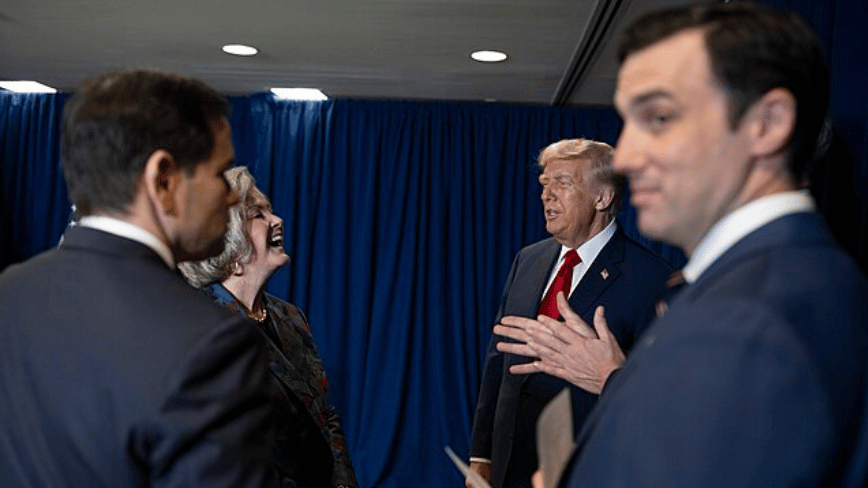
In a notable development, Anthropic CEO Dario Amodei met with White House Chief of Staff Susie Wiles and Treasury Secretary Scott Bessent on Friday. The meeting was characterized by the White House as 'productive and constructive,' focusing on the contentious issue of access to Mythos, an advanced AI model capable of identifying numerous zero-day vulnerabilities. This meeting appears to indicate a thaw in the ongoing standoff that arose when the Pentagon blacklisted Anthropic for its refusal to lift safety restrictions. Any potential resolution may likely exclude the Defence Department, channeling Mythos access through civilian agencies instead.
Amodei entered the West Wing on Friday for discussions with Wiles and Bessent, which the White House described as 'introductory, productive, and constructive.' The trio explored 'opportunities for collaboration' and shared protocols to tackle the challenges associated with scaling AI technology. President Trump later expressed surprise, indicating he had 'no idea' the meeting occurred.
This meeting represents a significant step toward resolving the ongoing standoff that has left Anthropic, a leading AI company, blacklisted by the government while the administration seeks access to its potent AI model. If an agreement is struck, it would likely exclude the Pentagon and instead route access through civilian agencies not involved in the original conflict.
Background of the Conflict
The current conflict traces back to late February when Defense Secretary Pete Hegseth demanded that Anthropic grant unrestricted access to its AI models for various purposes, including autonomous weapon systems and domestic surveillance. Amodei declined this request, emphasizing that while Anthropic is open to military collaboration, AI models are not yet reliable enough for such uses. Following this, Hegseth designated Anthropic as a national security supply-chain risk, effectively blacklisting the company from government contracts.
In response, Anthropic initiated legal action against the Trump administration in early March, filing two federal lawsuits claiming illegal retaliation. Initially, a federal judge blocked the blacklisting, but an appeals court reversed this decision on April 8. Although Anthropic is now excluded from Department of Defense contracts, it can still collaborate with other government agencies. Following the adverse court ruling, Anthropic sought assistance from Trump-affiliated consultants to facilitate a political resolution, culminating in Friday's meeting aimed at paving the way for a deal.
Interestingly, the impetus for Amodei's visit to the White House coincided with the announcement of Mythos on April 7, just ten days after losing the appeal. The model's capabilities are such that the government cannot overlook its potential.
Capabilities of Mythos
Mythos is a versatile AI model that has demonstrated an exceptional ability to detect and exploit thousands of previously unknown zero-day vulnerabilities across major operating systems and web browsers. In its testing phases, it successfully identified flaws that had evaded human scrutiny for decades. When tasked with developing functional exploits, it achieved success on the first attempt in over 83% of cases. Notably, Mythos is the first AI model to execute a complete 32-step corporate network attack simulation. The UK’s AI Security Institute has evaluated it as significantly more effective in cyber offense compared to previous models, with JPMorgan Chase CEO Jamie Dimon acknowledging its capability to uncover vulnerabilities for potential cyberattacks. The Council on Foreign Relations has deemed it an 'inflection point for AI and global security.'
Rather than releasing Mythos to the public, Anthropic established Project Glasswing, a controlled access initiative that allows around 40 vetted organizations—including industry giants like Amazon, Apple, Google, Microsoft, Nvidia, and JPMorgan Chase—to utilize the model for identifying and rectifying vulnerabilities before they can be exploited. The company has committed up to $100 million in usage credits for Mythos and $4 million towards open-source security organizations, reflecting its adherence to the safety principles that initially led to its conflict with the Pentagon.
Interests of Each Party
The Treasury Department is particularly interested in utilizing Mythos to identify vulnerabilities within its own systems. Various segments of the intelligence community and the Cybersecurity and Infrastructure Security Agency are already testing the model. The White House Office of Management and Budget is also working on establishing protections to permit federal agencies to access a controlled version of Mythos. Bessent's involvement in Friday's meeting symbolizes that the economic and financial security arguments for accessing Mythos have reached the highest levels of the administration.
On the other hand, Anthropic seeks to resolve its blacklisting, not due to a pressing need for Pentagon revenue—given its annualized revenue has reached $30 billion—but rather because the supply-chain risk designation undermines its credibility and creates uncertainty for government-related clients. Amodei is advocating for a resolution that restores his company's standing without compromising the safety commitments that instigated the dispute.
Geopolitical Considerations
The diplomatic dimension adds urgency to the situation. Anthropic plans to provide Mythos to select British banks imminently and is expanding its London office to accommodate 800 staff. The Bank of England's Governor Andrew Bailey recently identified Mythos as a cybersecurity risk, prompting an emergency briefing with the CEOs of the UK’s largest banks and various regulatory bodies. Canadian Finance Minister François-Philippe Champagne has also characterized Mythos as an 'unknown unknown' during IMF meetings.
This scenario raises concerns that America’s closest allies might gain access to a critical national security tool before the U.S. government does, creating an additional motivation for the White House to resolve the dispute beyond the initial disagreement over safety protocols. Bessent, representing the Treasury Department—one of the agencies most eager for access to Mythos—likely emphasized this point during the meeting.
Implications of the Meeting
The term 'introductory' used in the White House's summary is significant, indicating that Wiles and Bessent are establishing communication channels rather than finalizing an agreement. The ongoing litigation remains active, the appeals court ruling is still in effect, and Hegseth has not altered his stance. However, the fact that high-ranking officials like the Chief of Staff and Treasury Secretary met with a CEO of a blacklisted company and deemed the conversation productive reflects a noticeable shift in the administration's approach, which would have been hard to envision just six weeks ago.
Amodei has developed a highly capable cybersecurity tool as a byproduct of creating a general-purpose AI model, opted not to release it for safety reasons, faced government repercussions for maintaining those safety standards, and is now being sought after by that same government due to the tool's irreplaceability. This complex sequence is unfolding not within a congressional hearing or regulatory framework, but in a meeting within the West Wing, where influential leaders are striving to find a solution that aligns national security, commercial interests, and the safety principles that initiated the entire conflict. While Friday's meeting did not yield a definitive resolution, it confirmed a mutual desire among all parties to reach one.